
The bell rang, and the hallways came alive. As usual, she was monitoring the high-energy students as they made their way to class. Most teachers bemoaned hall duty, but she loved it. It gave her a chance to reconnect with former students—if only for a moment.
One student in particular caught her eye. She remembered being warned about him by others, but after a few tumultuous months, she understood his insecurities. He responded to sincere praise, not empty flattery. Specific, genuine words that acknowledged his unique gifts and quirky strengths resonated with him.
She proudly shared this discovery with her hallway colleague, who raised an eyebrow and said flatly, “I didn’t go into education to praise kids. I’m here to teach them.”
Stunned, she stood silent. The bell rang again. She nodded faintly and walked back to her classroom, her thoughts spinning. Was she being too nice? Was she seen as soft? Couldn’t she teach and still praise?
At that moment, a still, small voice spoke to her. “‘But the fruit of the Spirit is love, joy, peace, patience, kindness, goodness, faithfulness, gentleness, self-control’” (Gal 5:22–23, ESV).
A quiet peace settled over her heart. She had her answer: She knew how to put the fruit of the Spirit on display.
____________
Educators can be hard on themselves. There is always something we can do better, from planning lessons to managing student behavior. There will always be those who disagree with our decisions and students who remain defiant despite our best efforts. Add to this the unexpected twists and turns within a typical school day, and you have a perfect breeding ground for self-doubt and discouragement. Even the most dedicated teachers can begin to question their calling or wonder if their work is truly making a difference. Over time, our joy can slowly fade. Instead of thriving, we can find ourselves just surviving.
That’s exactly where the enemy wants us—overthinking and overworking, striving to be all things to all people, relying on our own strength, and running on empty. It feels noble, even admirable, to give until there’s nothing left. However, when our drive is flesh-driven rather than Spirit-driven, our focus is on ourselves and what we can do rather than on our Savior and what He can do through us. That makes all the difference. Instead of being fruit-bearing believers, we settle for a weary cycle of just getting by.
The Ancient Tug-of-War
The tension between striving in our own strength and surrendering to the Spirit isn’t new. It’s the same struggle Paul described in Galatians 5:17. “For the desires of the flesh are against the Spirit, and the desires of the Spirit are against the flesh, for these are opposed to each other, to keep you from doing the things you want to.”
No matter our role, the pull toward self-reliance never fully disappears. We all face moments when we’d rather control outcomes, fix problems, or prove ourselves. But when we shift from self-focus to Spirit-focus, everything changes. God never intended for us to carry the weight of the classroom or the school on our own shoulders. Isn’t that a relief? When we walk in step with the Spirit, the fruit of His presence naturally becomes visible.
Connecting to the Vine
Jesus talked often about fruit. Consider His thoughts on the matter recorded in John 15.
- He is the source. “‘I am the vine; you are the branches’” (v.5).
- To bear fruit, we must stay connected to the vine. “‘Abide in me, and I in you. As the branch cannot bear fruit by itself, unless it abides in the vine, neither can you, unless you abide in me’” (v.4).
- We are meant to bear fruit—much fruit. “‘Whoever abides in me and I in him, he it is that bears much fruit’” (v.5).
- Staying connected to the vine yields provision. “‘If you abide in me, and my words abide in you, ask whatever you wish, and it will be done for you’” (v.7).
- Bearing fruit brings glory to God and reveals our allegiance. “‘By this my Father is glorified, that you bear much fruit and so prove to be my disciples’” (v.8).
- We are appointed to be productive for the kingdom and to love one another. “You did not choose me, but I chose you and appointed you that you should go and bear fruit and that your fruit should abide, so whatever you ask the Father in my name, he may give it to you. These things I command you, so that you will love one another” (vv.16–17).1
These verses are familiar, but they become deeply personal when we pause to ask ourselves some key questions.
- Is my life yielding fruit?
- Is my fruit visible?
- Are others benefiting from it?
- Am I willing to do what it takes to bear more fruit?
- Am I staying connected to Jesus?2
If you’re like me, you read these questions and want to say an enthusiastic, “Yes!” Yet, if I’m being honest, I feel a little twinge of conviction when I respond in that manner. I’m guessing you do too. If we desire to answer these questions with a resounding “Yes!”, we must be intentional about becoming fruit-bearing educators.
So how do we do that—practically—without adding more to our already long to-do lists? Let me offer three simple but powerful shifts that can help us move from surviving (fruitless busyness) to thriving (Spirit-led fruitfulness):
1. Receive
Have you ever known someone who loves to give but struggles to receive? Many educators fit that description. We’re great at pouring out praise and service, but uncomfortable being on the receiving end. That might work in human relationships, but not with Jesus. He gave His life so we could receive not only salvation but also an abundant, overflowing life. In the Amplified version, John 10:10 says it this way: “‘I came that they may have and enjoy life, and have it in abundance [to the full, till it overflows].’”
Are you living out of overflow or out of depletion? Is your life filled with His love, peace, and joy? Sometimes, without realizing it, we slip into an earning mindset, believing we must do more, serve more, and prove more before we’re worthy of God’s love. However, fruit-bearing is only possible because of what Jesus did for us on the cross. We can’t manufacture biblical love, joy, patience, or kindness through sheer willpower.
The first step in bearing fruit is opening your hands and heart to receive what you’ve already been given. Will you let God love you? Will you let His peace replace your striving? Will you let His joy fill your weary spirit? Receive what He so graciously offers.
2. Resolve
Every educator knows that growth requires effort. Students can’t learn if they don’t engage; likewise, we can’t mature spiritually if we don’t make room for God to work in us. Scripture reminds us that God has already given us everything we need for a godly, fruit-bearing life (2 Pet 1:3). However, the world constantly competes for our time and attention, leaving many of us stretched thin and spiritually weary.
That’s why Peter urged believers to “make every effort” to pursue spiritual growth with diligence (2 Pet 1:5–9). The phrase “make every effort” implies earnest diligence. To be clear, this earnest diligence refers to daily drawing near to Him, not to striving harder in our own strength. Growth doesn’t come from gritting our teeth; it comes from yielding our hearts.
For educators, that may look like beginning the day with prayer instead of panic, reading Scripture before checking email, or choosing worship over worry. It might mean pausing before reacting, inviting the Holy Spirit to lead in a difficult conversation, or surrendering the day’s agenda back to God. Everything in our lives competes for our time and attention, but it takes persistence to stay connected to the Vine. We must pause and say, “Lord, guide me today. Teach through me. Love through me.” Resolve to stay connected to the Vine, my friend, and you will bear much fruit.
3. Recognize
Several years ago, a colleague approached me looking hurt.
“Are you mad at me?” she asked.
I was shocked. I hadn’t even realized I’d passed her in the hallway without making eye contact. My mind had been racing through my to-do list.
That small exchange convicted me. How many moments like that had I missed because I was distracted or hurried? How often had I walked right past divine opportunities to encourage, comfort, or simply notice someone?
As educators, we’re constantly interrupted by students, parents, staff, or last-minute schedule changes. What if those moments are not actually interruptions but invitations? If we truly believe in God’s providence, then nothing happens by accident. Every conversation, every challenge, every delay can be an opportunity to bear spiritual fruit.
One of my former students used to test every ounce of my patience. She interrupted constantly, rolled her eyes, and stirred up drama daily. I often prayed for strength just to make it through class.
One morning, however, I prayed differently. “Lord, help me see her the way You do.”
That prayer changed everything. I began to recognize her behavior as a cry for connection rather than defiance. Instead of reacting, I responded with calm words and quiet consistency. Over time, her attitude softened.
One day, she told me, “You’re the only teacher who doesn’t seem mad at me all the time.”
That wasn’t me. That was the Spirit of God working through me to display the fruit of kindness.
Our schools are filled with these divine moments. When we respond with gentleness instead of frustration, patience instead of irritation, and gentleness instead of judgment, others take notice. Those moments become living testimonies of the Spirit’s presence in us. Recognize where God is at work all around you, and join Him as He uses you to minister to others in your circle of influence.
Thriving with the Spirit
At the end of the day, we’re all on a journey. The goal isn’t perfection; it’s progress. We become more like Jesus as we abide in Him and walk in step with His Spirit. When we receive His love, resolve to stay connected, and recognize His work in and through us, our lives begin to overflow with spiritual fruit. We no longer live in a weary cycle of surviving but in the joyful rhythm of thriving, bearing lasting fruit that glorifies God and blesses others.
Educators, let’s resolve to shine Christ’s character. Let’s choose to praise with sincerity, correct with compassion, and lead with love. Remember, our influence reaches far beyond lesson plans or policies. It bears eternal fruit. Let this be our prayer today: Lord, help us receive Your Spirit’s power, resolve to walk in Your ways, and recognize Your hand in every interruption. Make us vessels of Your fruit so others may see You in us. In Jesus name, Amen.
Thriving with the Spirit
At the end of the day, we’re all on a journey. The goal isn’t perfection; it’s progress. We become more like Jesus as we abide in Him and walk in step with His Spirit. When we receive His love, resolve to stay connected, and recognize His work in and through us, our lives begin to overflow with spiritual fruit. We no longer live in a weary cycle of surviving but in the joyful rhythm of thriving, bearing lasting fruit that glorifies God and blesses others.
Educators, let’s resolve to shine Christ’s character. Let’s choose to praise with sincerity, correct with compassion, and lead with love. Remember, our influence reaches far beyond lesson plans or policies. It bears eternal fruit. Let this be our prayer today: Lord, help us receive Your Spirit’s power, resolve to walk in Your ways, and recognize Your hand in every interruption. Make us vessels of Your fruit so others may see You in us. In Jesus name, Amen.
REFERENCES
- Minor, Jacqueline. Taking Jesus to School: The Fruit of the Spirit on Display, Bloomington, IN. WestBow Press, 2025, pg. 15-16.
- Minor, Jacqueline. Taking Jesus to School: The Fruit of the Spirit on Display, Bloomington, IN. WestBow Press, 2025, pg. 16-17.
Want to Learn More?
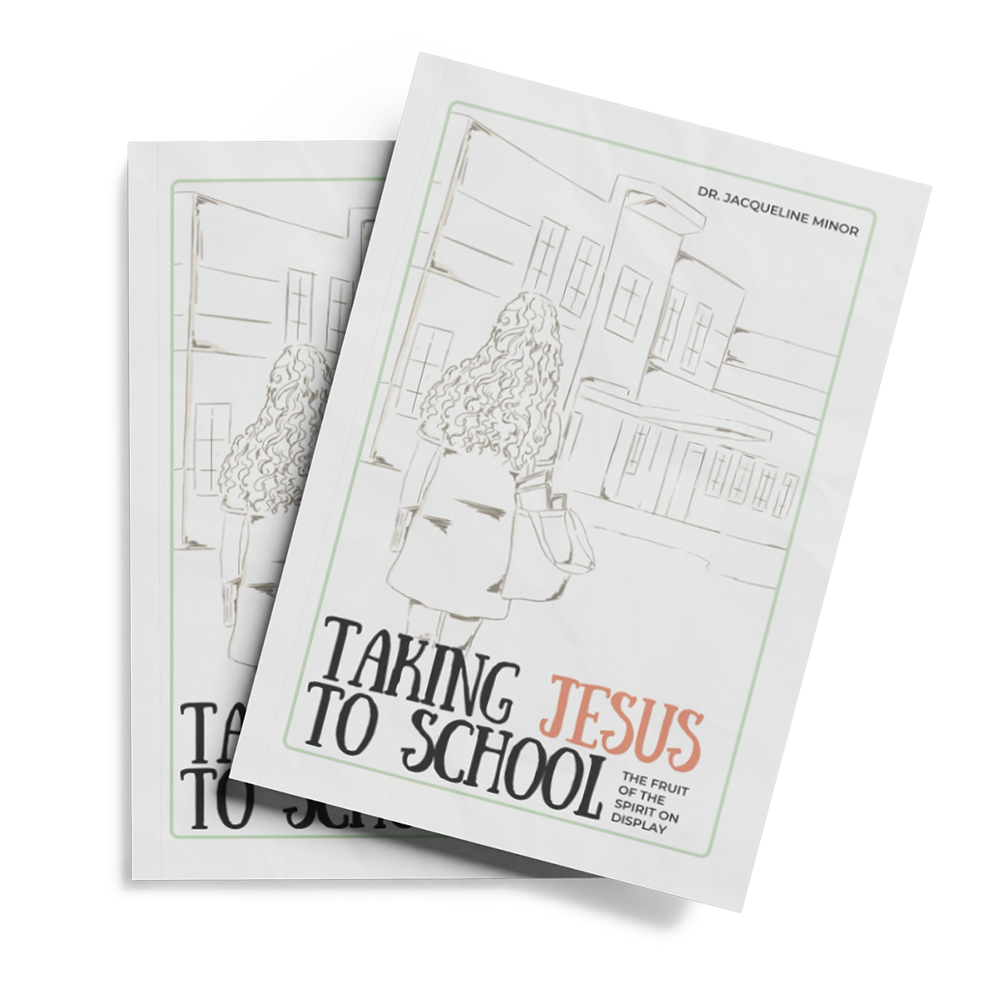
Taking Jesus to School: The Fruit of the Spirit on Display
In her book, Dr. Minor helps educators cultivate their faith journey, challenging and equipping them to unapologetically bear spiritual fruit. In this inspiring guide, she explores who Jesus is, what He was like, and how embracing His character through the Holy Spirit will enable educators to serve as His ambassadors in their schools.
Get your copy today!